
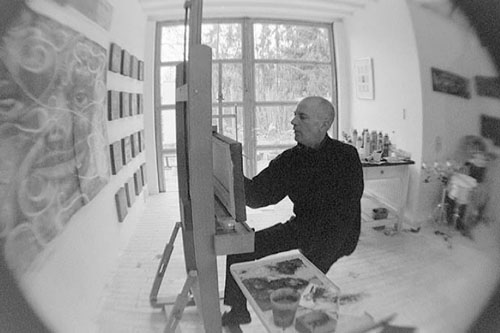
Who is Ingo Wegerl?

"Art should never give answers but raise questions.” With this premise Ingo Wegerl leads the onlooker in exploring new patterns of thought and ideology and finally in seeking the answers inside himself.

It all started while Ingo was living in the countryside of Europe. There, he spent endless hours exploring his village and the nearby forest as he played imaginary games. This keen imaginary ability has never left Ingo. In a way, you could say that Ingo is still childlike. Ingo’s art certainly is a manifestation of a skillful hand and a creative mind.

Ingo took his creativity with him to work later on. He began as a graphic designer and later illustrated medical books. So, those of you in the medical field have known Ingo’s work for longer than you might have thought. His precise drawings of the human body have been in use since the late 70’s and are still used in today’s most common medicine books in medical schools around the globe.

The enterprise of becoming an artist is a daring one. We all have heard of starving artists. In fact, a recent statistic in Europe suggests that only two percent of artists are able to support themselves with their art.

Still, art was the only option for Ingo and within a few yeas he made a name for himself. Ingo has held exhibitions in museums and galleries all over Europe since the mid 80’s.

In 2001, Professor Knut Nicolaus, of the University of Applied Science in Cologne, compared the artistic skills and ability of Ingo Wegerl to those of distinguished artists of the Pop Art, Montage (successor of the DADA movement), and New Realism eras. Particularly, his impressive and pro?cient command of the brush which enables him to achieve a unique quality reminding one of the old masters. Furthermore, Professor Nicolaus attests that Ingo Wegerl’s technique and methodology are of a quality equal to artists such as Martial Raysse and Gerhard Richter.

Most recently, Ingo revealed his latest creation a multimedia still painting. In addition, Ingo is commissioned to paint both the Culinary Hall of Fame as well as the Soccer Hall of Fame in Europe. Beckham, Pele, Beckenbauer and the culinary maestros like Borcuise, Witzigmann or Puck are amongst the people Ingo captures in his very unique style.

At opening events for his work, Ingo usually unveils a little surprise for his audience, such as his “multimedia performance without electricity.”

Biography:

Corporate Collections:

  • Hugo Boss, Besaczio, Switzerland
  • E.ON AG, Düsseldorf, Germany
  • Opel (GM), Rüsselsheim, Germany
  • Credit Suisse, Ascona, Switzerland
  • Stinnes AG, Essen, Germany
  • Vogue, Paris, France
  • Schwarz Pharma, Monheim, Germany

Private Collections:

  • Prof. Dr G. Kober, Frankfurt, Germany
  • Prof. Dr. G. Konrad, Mönchengladbach, Germany
  • K. H. Mikosch, Düsseldorf - Saint Tropez - Zürich
  • Foundation E. Janzen, Mönchengladbach, Germany
  • H. Rebock, Bolgheri, Italy
  • Dr. Dembon, Berlin, Germany
  • K. Wirtz, Marbella, Spain
  • R. Morandi, Zürich, Switzerland

Museum Exhibitions:

  • Von der Heydt Museum, Wuppertal, Germany
  • Deutsches Sportmuseum, Cologne, Germany
  • Weber State University, Ogden, USA
  • Museum für Zeitgenössische Kunst, Mönchengladbach, Germany
  • Grand Palais, Paris, France
  • Museum Schloss Rheydt, Mönchengladbach, Germany

Galleries and Art Fairs:

  • Gallerie Olaf Zimmermann, Cologne, Germany
  • Gallerie Sacchetti, Ascona, Switzerland
  • Gallerie an der Düssel, Düsseldorf, Germany
  • Gallerie Morantin – Nouvion, Paris, France
  • Gallerie Migame, Paris, France
  • Gallerie Storms, Groningen, The Netherlands
  • Kunstraum Stinnes, Essen, Germany
  • Academie de Peinture de Nice, France
  • Salon du Autum, Paris, France
  • Grand Palais, Paris, France

Current Projects:

  • Culinary Hall of Fame
  • German Soccer Hall of Fame

Future Exhibitions:

  • Hugo Boss, Besaczio, Switzerland
  • Vodaphone, Düsseldorf, Germany
  • International Art Center, Venlo, The Netherlands
  • Frankfurt Airport, Germany
  • “Fuss – Ball – Kunst”, Opel (GM), Rüsselsheim, Germany

Publications:

  • Dr. Werner Schulze-Reimpel, Ingo Wegerl und der Phantastische Realismus, Artis Kunstmagazin, Basel 1980
  • Dr. Sabine Felemann, Petra Jeschonek, Ingo Wegerl – Neue Bilder und Bildprojekte, Mönchengladbach, 1982
  • Prof. Dr. med. Michael Hertl. Kinder- Malerei von Ingo Wegerl, ISBN 3-926141-18-2
  • Edition Galerie Franken Zimmermann, Querschnitt No. 3, Ingo Wegerl, - Bilder und Bildobjekte, ISSN 0936-3688, Köln 1989
  • Dr. Barbara Maiburg, Ein Italienischer Werkskomplex von Ingo Wegerl, Möchengladbach 1997

Illustrations:

  • Sabota Atlas des Menschen , 18. Auflage, ISBN 3-541-02828-9, Urban & Schwarzenberg, München – Wien, 1982
  • Carmine D. Clemente Ph.D., University of California at Los Angeles School of Medicine, Anatomy, A Regional Atlas of the Human Body, III Edition, ISBN 0-8067-0322-9, Urban & Schwarzenberg, Baltimore 1982
  • Prof. Dr. med. Helmut Ferner, Pernkopf – Atlas der topographischen und angewandten Anatomie des Menschen, ISBN 3-541-02122-5, Urban & Schwarzenberg, Wien, 1982
  • Dr. Dr. Hans Ulrich Sons, Ingo Wegerl, Das Herz und seine Erkrankungen, Universität Düsseldorf, 1985
  • Dr. med. Friedrich Kahle, Ingo Wegerl, Herz-Koronarsklerose und Infarkt in dreidimensionaler Betrachtung, ISBN 3-980

Public Art Projects:

  • Altar paintings in “Madonna della Pieta“ Bibbona, Italy
  • Altar paintings in La California, Italy
  • Academy for Applied Science, Krefeld, Germany
 
info@ueberformat.com
Who we are 
 
  P.O. Box 615, San Francisco, CA 94104-0615
phone: +1 415 440 3081
© ueberformat 2004